
Marie Jane Naylor (1856–1940),
artist and suffragette
Martin Ferguson Smith
Abbreviations used in text
BB – Galerie Le Barc de Boutteville (Galerie Dosbourg), Paris
L – Walker Art Gallery, Liverpool
M – Manchester City Art Gallery
NEAC – New English Art Club
’91 Club (women’s art club founded 1891)
RA – Royal Academy of Arts, London
RAS – Royal Academy Schools, London
RHA – Royal Hibernian Academy of Arts, Dublin
ROI – Royal Institute of Oil Painters
RSBA – Royal Society of British Artists
Salon – Salon du Champ de Mars / Salon de la Société Nationale des Beaux-Arts, Paris
SWA – Society of Women Artists
WIAC – Women’s International Art Club
Mary (later ‘Marie’) Jane Naylor was born on 13 February 1856 at 16 Constable Row, Mile End Old Town, Stepney, the address of her parents’ home in East London. Her father, John Naylor, was from Leeds, Yorkshire. Starting as a salesman, he established a successful business as a clothier. Her mother, Mary Amelia Naylor, was the daughter of Samuel Avila, a Stepney pawnbroker and silversmith. Samuel Avila, son of a man of the same name, was of Sephardic Jewish descent. The surname is linked to the historic centrally situated walled Spanish city of Ávila, from which the sizeable Jewish population was expelled when the Alhambra Decree was issued on 31 March 1492: Jews were given four months either to convert to Christianity or to leave the country. Mary Amelia carried on her father’s business. She is described on her death certificate as ‘salesman of unredeemed pledges’, that is to say ‘pawnbroker’.
John and Mary Amelia were married in Stepney Parish Church on 26 October 1852, when he was twenty-four, she twenty-three. His father, Sampson Naylor, is described on the marriage certificate as ‘Physician’. The couple were to have four children in addition to Marie: Amelia (1853), Emily (1857), John Alfred (1868), and Henry (‘Harry’) Charles (1870).
There is no information about Marie’s earliest school education. At the time of the 1871 census, when she had just turned 15, she was attending a small boarding school near her home, at 35 Stepney Green. The building had been part of a Jewish old people’s home. Four teachers are listed: Emma Gold as head, assisted by her unmarried sisters, Elizabeth and Mary Ann. The Gold sisters, all in their fifties, may have been of Jewish descent, but neither the fourth teacher, Sarah Wallis from Yorkshire, nor any of the eleven children in their care has an obviously-Jewish name. If indeed the establishment was run by a Jewish family, one wonders if Marie might previously have been a day pupil at the Stepney Jewish School, established in 1864. But the parents’ Church marriage and their choice of names for their children suggest that they may have wished to play down Mary Amelia’s Jewish heritage. The only clue to Marie’s religious beliefs is at the end of the will she made on 3 December 1938, and her words support, or at least do not conflict with, respect for Jewish values:
I thank God for my life & trust my soul unreservedly in his hands ‘Maker remake complete I trust what Thou shalt do’ ‘I end with Love is all & death is naught quoth she’.
Both quotations are of Robert Browning, a poet noted for his Jewish sympathies. The first is of ‘Rabbi Ben Ezra’, the second of ‘Fifine at the Fair’. One can speculate that her choice of words from the poem about Abraham ibn Ezra, a Jew who lived in medieval Spain, may have been influenced by her Sephardic ancestry.
Sometime between late 1879 and April 1881 she entered the St John’s Wood Art Schools established by the Peruvian artist Abelardo Alvarez Calderón at 7 Elm Tree Road, St John’s Wood, London NW. It was informally known as ‘The Wood’. She cannot have enrolled earlier because the school had not yet opened,[1] and the 1881 census, held on 3 April, provides a terminus ante quem, describing her as ‘Art Student Painting’, almost certainly at The Wood. At that time she was twenty-five, older than many of the students. She was living with her parents, and one can only guess what she had been doing since she left school. Assisting in her parents’ businesses is an obvious possibility.
The main aim of The Wood was to prepare students for the Royal Academy Schools (RAS), and in this it achieved extraordinary success. In the last two decades of the 19th century the majority of RAS entrants admitted to study painting had been trained by Calderón and his staff. I have described elsewhere, in my biography of Marie’s artist friend and contemporary Helen Coombe, what it was like to be a female student at The Wood and RAS in the 1880s, and I refer readers to that account.[2] Here I repeat only those points which are particularly applicable to Marie.
She would have worked long hours at The Wood, and would have had to achieve proficiency in drawing from the Antique before she was permitted to paint, and even then painting from life would have been forbidden until she had been trained in the use of brush and palette. Students worked in a large room crammed with casts of ancient statues and busts on pedestals. The preliminary work might have been considered dull by someone who was not strongly motivated to become an artist. Evidently Marie did have that motivation.
She was admitted to the RAS as a probationer on 30 December 1882, to study painting. Prior to 1868 the Royal Academy had occupied premises, shared with the National Gallery, in Trafalgar Square. It then moved to its present premises in Burlington House, Piccadilly. To be accepted as a probationer, Marie would have been required to submit a chalk drawing, at least two feet high, of an undraped ancient statue. She would have been required to submit also anatomical drawings of a figure, ‘showing the bones and muscles, in two distinct drawings, with the names of the several muscles, tendons, and bones contained therein’.[3] To ensure no cheating, the second set had to be executed at the Academy. Marie qualified as a full student on 13 March 1883, again for painting. She would then have received her inscribed ‘ivory ticket’ or ‘bone’, showing on one side the words ‘ROYAL ACADEMY ANTIQUE School / 1768’, on the other her name with her date of admission.
During her student years in the RAS she would have started in the Antique School and moved on first to the Preliminary Painting School, then to the Upper Painting School. In the Upper School there were separate classes for women and men. Throughout her period of study the Professor of Painting was John Evan Hodgson, a congenial man, whose paintings often had an ‘oriental’ flavour after a visit he made to North Africa in 1868. One wonders whether he influenced Marie’s choice of From Egypt as the theme of one of her early paintings.
Marie was one of 64 women students in the RAS to sign a petition, presented to the President and Council of the Royal Academy on 4 December 1883, requesting a life class for the study of the partially draped figure.[4] The petition was granted, although only for study of the partially draped female figure.[5] Discrimination against women students in respect of models for life classes was to continue for some time yet. Details are to be found in my book about Helen Coombe, as are statistics dispelling the misapprehension, prevalent in the 1880s, that female students outnumbered males in the RAS. The opposite was the case, and the distortion of the facts may be interpreted as a further manifestation of the discrimination, albeit an unconscious one.
Whereas The Wood had charged tuition fees, there were (and are) none at the RAS, but students had to supply their own materials. In Marie’s time, the maximum period of a studentship was six years, divided into two three-year terms, and students could not proceed to the second term without passing a rigorous examination. Unlike Helen Coombe, Marie did not pass it, and so left the RAS at the end of 1885. It may be the case that she was glad to leave and spread her artistic wings in the wider world. She had already exhibited pictures with the Royal Society of British Artists, and in 1886 she had her first acceptance from the Royal Academy.
Marie was almost a year into her RAS course when her mother, Mary Amelia Naylor, died on 25 November 1883 from intestinal ulceration and heart failure. For some years after she left the RAS (1886–1891) she lived with her father when she was in London, at Norfolk House, 38 Lonsdale Road, Barnes. The arrangement would have been economical, and Marie, being the elder unmarried daughter, may have felt a certain obligation to keep her father company. Her elder sister, Amelia, had married William Boyd Denman on 29 July 1878. William was a commercial clerk, but the son of an artist, John Flaxman Denman (1808–1887), which is likely to have interested Marie. However, soon she was spending time in Paris, learning and working. She enrolled as a student in the Académie Colarossi at 10 rue de la Grande Chaumière in Montparnasse, close to the Latin Quarter. The Ladies’ Field calls her ‘one of the best-known women artists to have studied in the school’.[6] She lived nearby at rue Delambre, 7. She exhibited pictures at the Salon and soon gained a reputation in France at least as high as the one she was establishing in Britain. It was in Paris, according to her own testimony, that she ‘began to have some idea of what drawing might mean’ and gave up painting for many months to concentrate on drawing.[7] The only thing that is a little surprising about this account is that her training in London art schools had prioritised drawing over painting in the early stages, although admittedly the requirement there was the drawing of antique statues. Marie does not mention another activity, permissible for women in the Académie Colarossi but impermissible for them in the Royal Academy Schools, the drawing of nude male models.
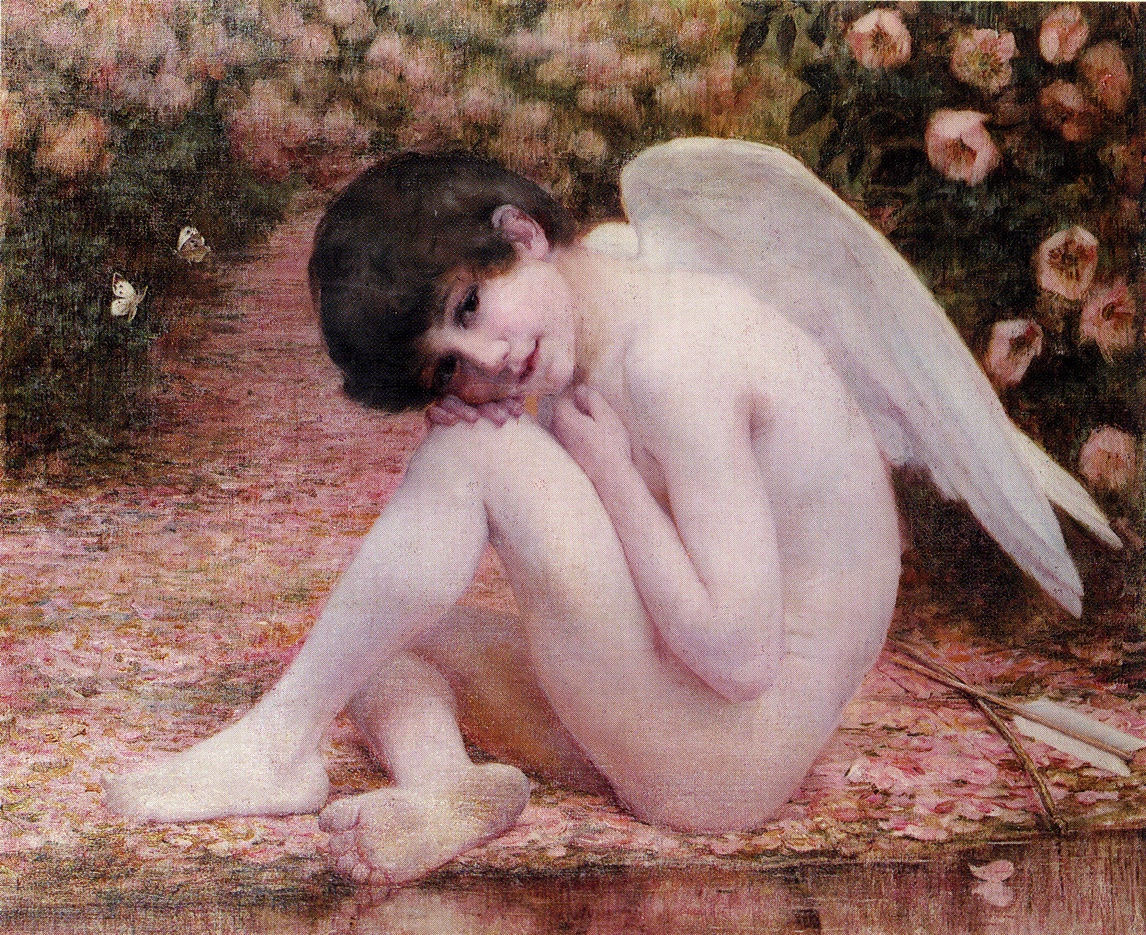
The illustrations are of works by Marie J Naylor (1856–1940) unless otherwise stated
1 Cupid, 1890. Oil on canvas, 61 x 76 cm
Prominent among the early pictures she exhibited were studies of fruit and flowers (Grapes; Autumn Fruit; Marigolds; Chrysanthemums), figurative paintings, and portraits. The second group included Cupid (Pl 1) and several depictions of anticipation or suspense: Waiting for Father; Waiting for the Postman; Waiting; Post Time; and Before the Dance. As for portraits, most of her subjects, all through her career, were female: Blanche was followed by Florence; Edith; Miss Helen Coombe; Portrait of the Artist; Woman with Fan-shaped Hair Clips; Miss Sophie Youngman; and later by Lilian; Miss Castle; Miss A.M. Martineau; Gertrude; and Mrs. J.N.O. Thurston.
The only portrayals of men in my list of her works are one of her father (c1893), her Portrait of Canon Holland (1903), the theologian who was to become famous as the author of Death Is Nothing at All (1910), and her hand-coloured engraving of The Duke of Devonshire Carrying the Orb. The last-mentioned work was acquired by the American artist and art patron Narcissa Niblack Thorne (1882–1966). One can see why she would have been interested in having it, because her speciality was the creation of meticulously faithful miniature models of grand rooms in royal or upper-class houses, and she was commissioned to make, for the expected coronation of King Edward VIII, a grand room modelled on one at Windsor Castle, but it is harder to understand why Marie would have been interested in portraying the Duke close to the time of King Edward VII’s coronation in 1902.
Two of Marie’s portraits excited more interest than any others. One is her self-portrait. Exhibited at the Salon in 1889, when she was thirty-three, it was praised by the distinguished and influential art critic Albert Wolff in Le Figaro,[8] and the Journal des Artistes found it full of charm.[9] Admittedly, the review in Le Bon Citoyen[10] found it bland and anaemic, but Marie’s subtle style is typically quiet and restful, and clearly this was not to one reviewer’s taste. The picture, which showed the artist seated out of doors and facing forward, was re-exhibited at the RA in 1890 and at the BB in Paris in 1898. A critic who saw it at the RA commented that its ‘grey tone and light draped background … are pleasing’.[11]
The other portrait of Marie’s which attracted the most attention and the most favourable comment was her life-sized one of Helen Coombe. Its first appearance was at the Salon in 1888, where it was described in the Illustrated London News as ‘a distinguished and delicate portrait hung on the line’.[12] When it was re-exhibited at the RA in 1889, The Times called it ‘clever’, [13] and The Pall Mall Gazette praised ‘a “pink girl” very attractively presented’. [14] It was to be exhibited again at least three times. Its third known appearance was among about forty of Marie’s paintings chosen for her solo exhibition at the BB in May–June 1898, when it received further praise, d’Hennebaut drawing particular attention to it in his favourable review of the entire exhibition, which he pronounced ‘very personal, original, and extremely delicate’ (‘très personnelle, originale et d’une délicatesse extrême’). It was admired also by another reviewer of the exhibition, Eugène Hoffmann, for its ‘great simplicity of execution’ (‘la grande simplicité d’exécution’). [15] It was praised again when it was shown at the exhibitions of the ’91 Art Club in 1899 and the WIAC in 1904. The art critic of The Queen placed it among ‘specimens of portraiture of distinct merit’ and revealed that it showed Helen ‘seated, with a fan on her lap’,[16] but more informative is the article ‘Select Works by Lady Artists from Their Original Sketches’, printed in the same newspaper in 1889.[17] One of the artists featured is Marie, and her sketch (no. 10) is Portrait of Miss Coombe (Pl 2), described as ‘an able example of that art [portraiture] in the character of both face and figure.
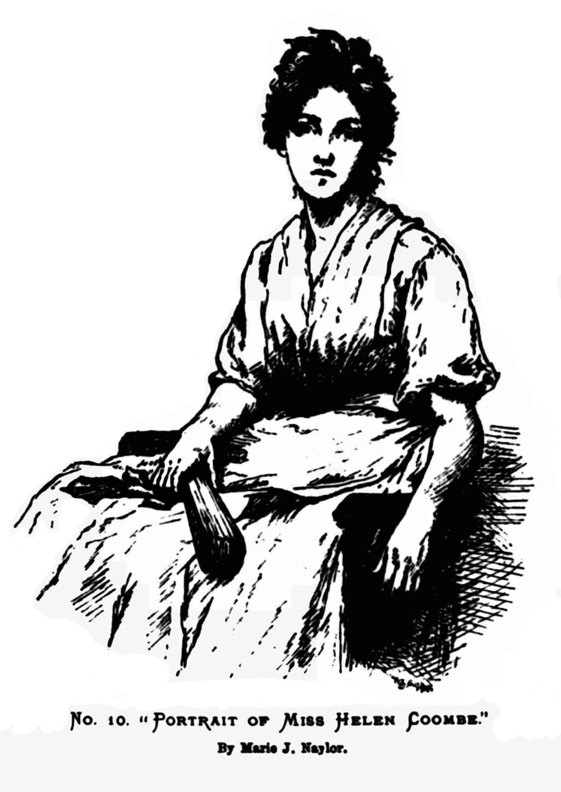
2 Miss Helen Coombe. Sketch by the artist reproduced in The Queen, 9 February 1889, p175
Simply posed, the form is still not without grace, and a thoughtful tender expression adds additional charm’. The small size of the reproduction, the poor quality of the engraving, and the absence of colour conspire to make fair assessment of the portrait difficult, but the sketch is much better than nothing, and it is helpful to have the comments of contemporary critics, including: ‘Marie Naylor’s portrait … is quiet, and possesses that indefinable something we call quality. It is restful because the tones blend so subtly. The colour is something between a pale buff and a pale terracotta, and through this charming portrait – dress, hair, face, and arms – that sensitive colour runs’;[18] and ‘brown and pink, well drawn, well thought out, and effective in its tranquil way’.[19]
Marie’s portrait of Helen seems never to have been offered for sale, which suggests that she had a special feeling for it. Her choice of Helen as a subject no doubt had something to do with the friendship that is likely to have developed during their student years. But one can reasonably assume that she chose her also on account of her attractive appearance and character. Despite being cursed with bad teeth, Helen was admired for her good looks, and still more for her outstanding personality and intellect.
We have seen that Marie first exhibited in Paris no later than 1888. We learn that she did so in the second year of her time there,[20] presumably while she was a student at the Académie Colarossi. Her solo exhibition at the BB ten years later is indicative of her artistic reputation in Paris at that time. Between those dates she may have been dividing her time almost equally between Paris and London. Reviewing her 1898 exhibition, d’Hennebaut says that she had been known in Paris ‘for several years already’ (‘depuis plusieurs années déjà’) as an exhibitor at the Salon. There are other indications of her being in France rather than England. One is her absence from the English census returns on 5 April 1891. Another is that, whereas she exhibited in Dublin each year from 1887 to 1890, there was a four-year gap before she resumed in 1894, and there is an identical gap in her exhibits at the Royal Academy. Also, with the exception of two pictures which she re-exhibited in Manchester that year, the only works of hers known to me from 1891 were painted in Paris. One is Woman with Fan-shaped Hair Clips (Pl 3). The other is Une chansonette. Her Paris address was now rue Dareau, 81.
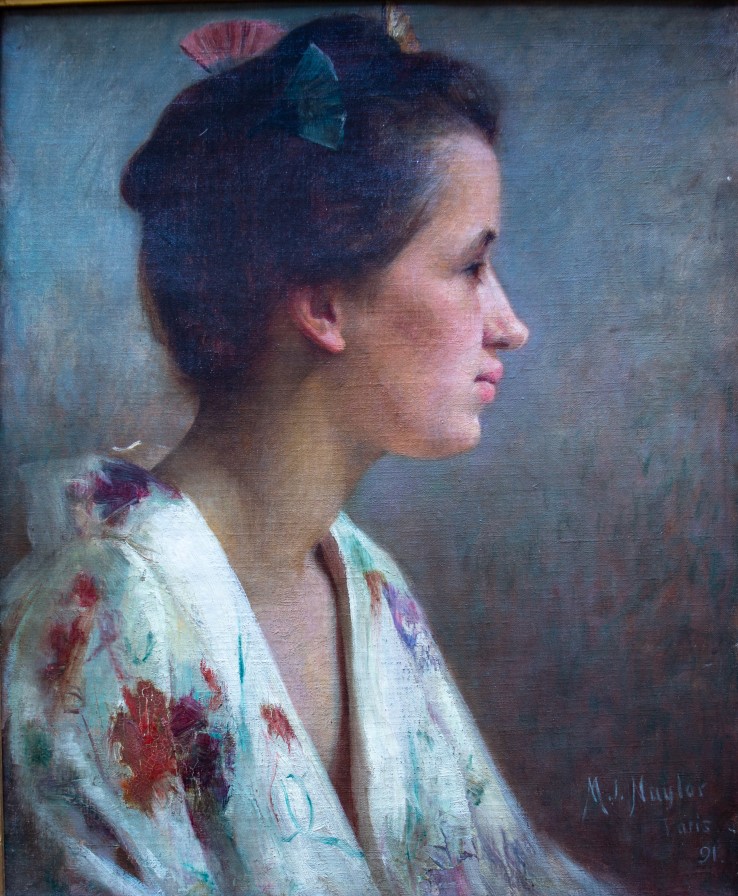
3 Woman with Fan-shaped Hair Clips, 1891.
Oil on canvas, 48 x 40 cm. Private collection
Marie did not abandon London. In 1892–1893 her professional address was 7 Primrose Hill Studios, Fitzroy Road, very close to Regent’s Park and the London Zoo. She shared the premises with fellow artist Rose Mackay. It was one of twelve studios purpose-built for artists by Alfred Healey in 1877–1882. Constructed of red brick with slate roofs and high ceilings, the cottage-like units (which survive) surrounded a courtyard, and there was a lodge occupied by a couple who could organise the cleaning and provide main meals. One of those who worked in this lively artistic community, and did so for over 20 years, first in no. 3, then, from 1887, in no. 6, was John William Waterhouse.[21] He did not live in his unit, and it is not known whether Marie and Rose lived in theirs. In any case, if Marie was spending much time in Paris, she could only have been a part-time resident. One small puzzle is why The Post Office London Directory for 1893 (London; Kelly) has her as ‘Naylor Miss Maria Isabel, artist’. Maria is very close to Marie, but Isabel is a long way from Jane. The mistake is reproduced by others, including Elizabeth Crawford, who errs also in giving Marie’s date of birth as c1866.[22]
(Eugénie) Rose Mackay (1868–1954) had exhibited at the NEAC (1890) and the RA (1891), also at the Salon (1889), and it was probably in Paris, her mother’s birthplace, that she and Marie met, when both were studying at the Académie Colarossi. Rose’s chief teachers there were Raphaël Collin and Gustave Courtois. Before that, she had private lessons in England from William Fitz,[23] who later tutored LS Lowry. When she was an NEAC exhibitor, she gave her address as 1 St George’s Terrace, London NW. This was the prestigious address of her affluent parents, James Hayward and Eugénie Anne Mackay, née Slade, and is situated very close to Primrose Hill Studios.
Only two of the portraits of women and girls mentioned above have been located, and not all the subjects have been identified. Blanche is perhaps the artist Blanche Mathewes (1860–1914), well known to Marie; Edith might be the younger sister of Helen Coombe, the sibling to whom Helen was closest in affection as well as in age. When the picture was first exhibited in 1888, Edith Coombe, born on 17 November 1865, would have been twenty-two. Aileen Maud Martineau (1865–1955) was in her late thirties when her portrait was entered for the WIAC exhibition in 1903. She married George Seymour Fort in 1906. Gertrude (Aldham), the daughter of Alfred Charles and Julia Florence Aldham, was born on 17 May 1890 and so was aged 14 at the time her portrait was exhibited in 1904. Evelyn Theodosia Thurston, née Daubeny, was the wife of John Neville Oldfield Thurston, who saw service in the British colonial administration in Burma. They married in 1896 and had one son. She was born in 1876, so was in her early thirties when the portrait was exhibited. She was soon to be widowed, for he died on 19 December 1908. She died in Canada in 1958.
It is unlucky not only that Marie’s self-portrait is missing, but also that no engraving of it is contained in Royal Academy Pictures or elsewhere.[24] But one significant consolation, recently brought to light, is that a portrait of her by Helen Coombe, probably executed c1888, survives.
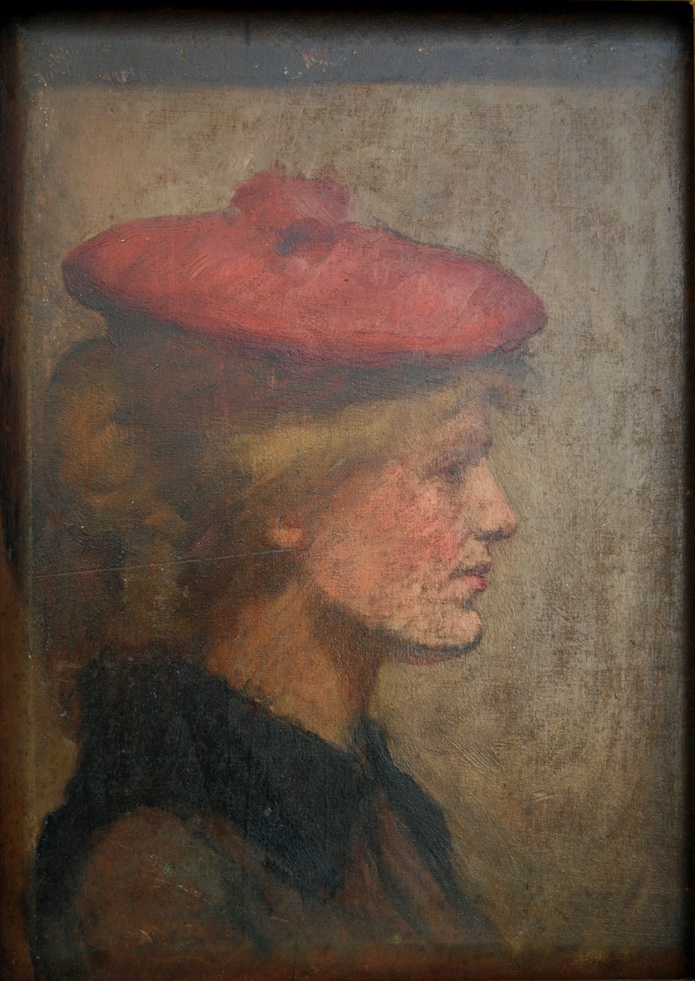
4 Marie Jane Naylor by Helen Coombe (1864–1937) , c1888.
Oil on canvas, 24 x 34 cm. Private collection
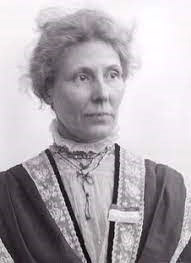
The picture, first presented and discussed in my biography of Helen[25] and reproduced here (Pl 4) is a quarter-length study in profile of a brown-haired woman wearing a red beret with a pompom. When I was not one hundred percent confident of my identification of the sitter, I called the picture Woman in a Red Beret. But, after further inspection and thought, including further comparison with other known images of Marie (Pl 5, Pl 6), I am convinced that she is the woman portrayed.
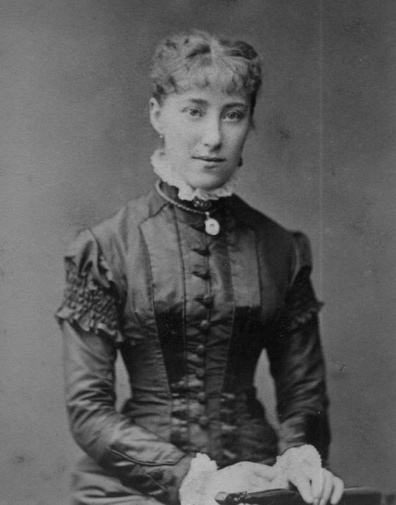
5 Marie Jane Naylor, c1895. Photograph
6 Marie Jane Naylor, c1908. Photograph
The nose, mouth, and bone structure are the same, and the beret, never a fashionable item in late Victorian and Edwardian England, well suits a feminist with close French connections. The portrait, despite being filthy dirty, is an accomplished piece of work.
It was probably sometime between 1891 and 1894 that Helen Coombe spent what a friend of hers called ‘a starvation year’ in Paris and returned to London in poor physical shape. It is likely that she and Marie were in frequent contact during this period, but it is not known whether they lived or worked together.
In 1894–1898, as in 1886–1891, Marie’s address is shown in The Year’s Art as her father’s, but in 1895 and 1896 she gave it to the RA as 6 rue Boissonade, Paris. The street, in the Montparnasse area, was much favoured by artists, and no. 6 was the address of Auguste François-Marie Gorguet (1862–1927), a versatile painter and lithographer. He was there by 1886 and remained until at least 1896. One of many other artists who had a studio in the house at one time or another was Helena Darmesteter, who had the misfortune to see it destroyed by fire in December 1891. Whether Marie lived in the house or just had her studio there we do not know, but in either case it is reasonable to conclude that she benefited not only from the teaching at the nearby Académie Colarossi, but also from her association with members of the wider artistic community.
Some mystery surrounds two accomplished portraits, attributed to Marie, in a private collection. They form a pair in that they are identical in size and were painted on canvas supplied by Paul Foinet of Paris, but the subjects are not so obviously a pair. One is a bearded man who looks to be well into his sixties. The owner is almost sure that he is Marie’s father, John Naylor (Pl 7). The identity of the other subject, a woman significantly younger than the man, is uncertain (Pl 8). The owner’s family tradition is that she is ‘Amelia’.
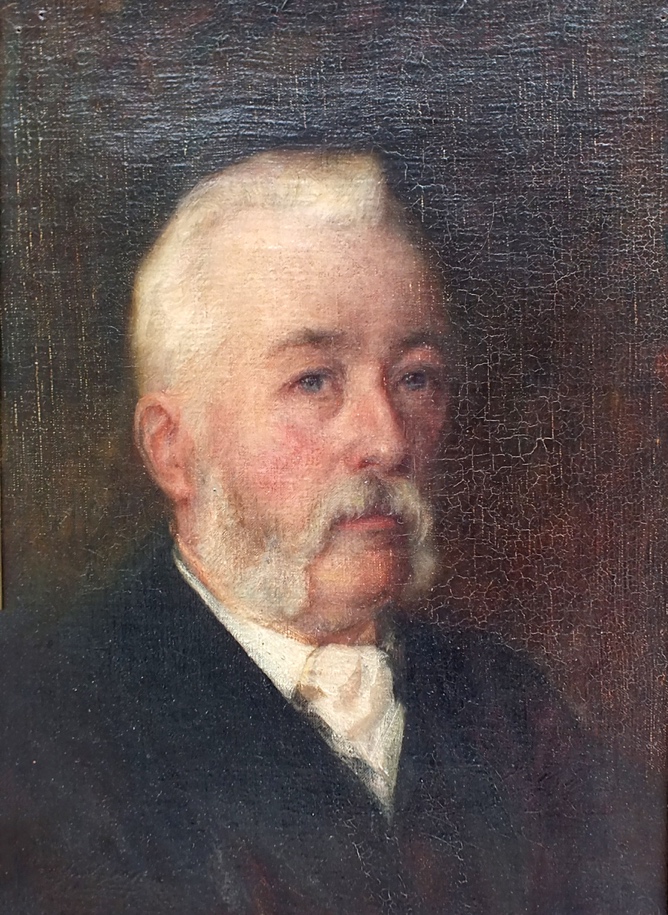
7 John Naylor, c1893. Oil on canvas, 24 x 32.5 cm. Private collection
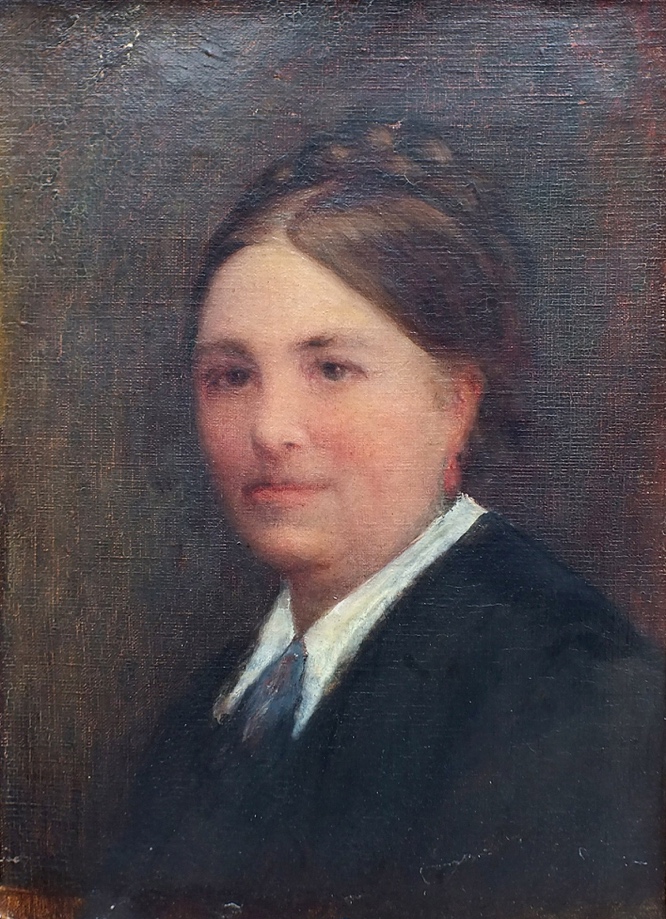
8 Amelia Denman (?), c1893. Oil on canvas, 24 x 32.5 cm. Private collection
She cannot be Marie’s mother, Mary Amelia, unless the painting was modelled on a photograph, because she had died in 1883, many years before the portraits were executed. A more plausible candidate is Amelia Denman, John and Mary’s eldest daughter. Since both portraits are painted on French canvas, one would expect them to have been executed in France, although perhaps from drawings made in England. The canvas cannot have been made later than 1897, as the ‘Paul Foinet’ stamp, not used after that date, shows. If the male subject is a sexagenarian John Naylor (born in 1828), a date for the portraits c1893 is likely.
At a date uncertain, but probably in the late 1890s, Marie suffered some sort of a breakdown.[26] Our source attributes it to hard work, but one likely contributory cause was her father’s disapproval of her support of women’s suffrage. His attitude apparently impacted the will he made on 10 April 1897. Marie refers to its ‘inequality’ in her own will. John Naylor bequeathed his leasehold house, furniture, and other household items to Marie’s younger sister, Emily Naylor. There were also bequests to his two sons and his sister Mary Ann. Marie and her elder sister, Amelia Denman, are not named, but may have received some benefit through their father’s bequest of the remainder of his estate to ‘such of my children as shall survive me in equal shares’. John Naylor died on 23 December 1902, aged seventy-four, and although Marie was staying in his house on the date of the 1901 census (31 March), in 1899 she ceased to give his address as hers and rented a small working and living space at Stamford Bridge Studios, Fulham Road, Chelsea, London SW. The studios were a ramshackle late-19th-century development by Marwood Gooding, a Devonshire-born builder, who wanted to provide affordable quarters for impecunious artists (Pl 9).
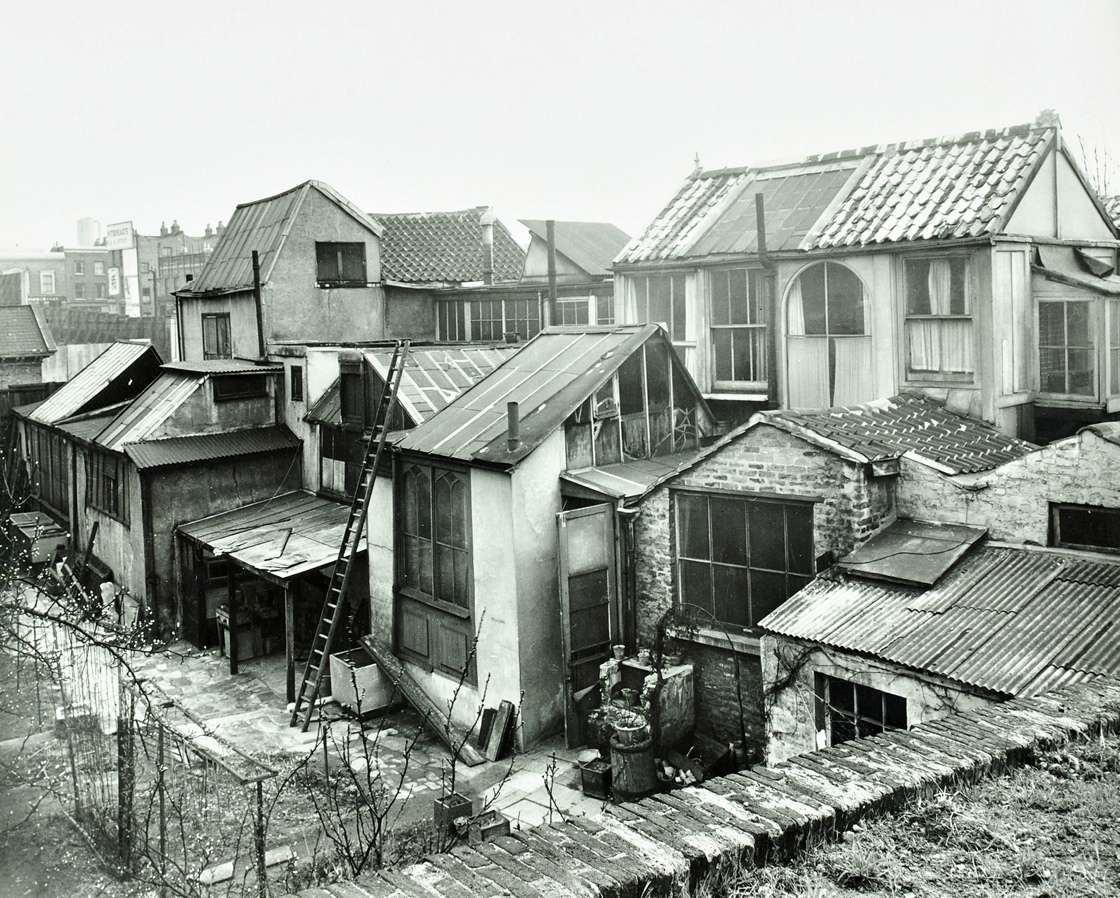
9 Stamford Bridge Studios, 1959. Photograph just before demolition.
London Metropolitan Archives, LCC Photograph Library, cat. no. SC_PHL_04_17_73_4509
They were to continue to be Marie’s address until her death in 1940, and her tenancy of 41 years was longer than anyone else’s. A fellow tenant early in her time (1906–1907) was the sculptor Jacob Epstein. The studios were demolished in 1959. [27]
The apparent rift between father and daughter occurred at a time when she was ‘a member of the old Suffrage Society’,[28] but not yet a militant campaigner prepared to break the law. She seems not to have belonged to the Women’s Franchise League, founded in 1889, but she was a member of the National Union of Women’s Suffrage Societies, established in 1896, and that would tie up with John Naylor’s inequitable treatment of her in his will the following year. Her activities in 1907 and the following years would have been likely to make him turn in his grave.
As well as treating Marie in his will far less generously than his other unmarried daughter, he may in his last years have withdrawn or reduced any allowance he had previously been giving her. If so, that would help to explain why she could not afford accommodation more spacious and comfortable than a Stamford Bridge studio. Her will, dated 3 December 1938, makes clear that her father’s actions caused her hardship. At the same time she thanks her brother Harry ‘for many kind services at the time of my father’s death & during the suffrage campaign’. She also thanks other family members for their support, including her sister Emily since 1917.
With so little of Marie’s work available for inspection, it is difficult to assess its quality, but the available pictures show technical skill combined with a quiet sensitivity. A possible obstacle to the appreciation of some viewers is the sentimentality of some, perhaps many, of her pictures. An example is Un trésor (A Treasure) of 1890, portraying a young girl looking forwards and down, her eyes fixed on a small bird in a fold of her dress. But a warning against dismissing ‘Victorian Sentimentality’ as incompatible with good art was the wise message of an exhibition with that title staged by Tate Britain in 2012. Marie was painting the sort of pictures expected of artists in late Victorian and Edwardian times and doing it well. Sometimes she even followed leading artists of the time in giving her pictures the same titles as theirs. One notable example is Her Eyes Were with Her Heart, and That Was Far Away. The words, which are based on Byron’s poem ‘She Walks in Beauty’, are the title of a painting she exhibited in 1887, but they are also the title of a picture painted in 1875 by Philip Hermogenes Calderon, now at Sudley House in Liverpool, except that his title has ‘Are’ and ‘Is’, not ‘Were’ and ‘Was’. A second example is her (Soap) Bubbles (1898 or earlier), which is also the title of a famous picture painted in 1886 by John Everett Millais (Pl 10). The original title of Millais’ work was A Child’s World, but in 1887 it was acquired by the chairman of Pears Soap and was soon used to advertise that product. Marie’s picture (Pl 11) is far from being a copy of Millais’.
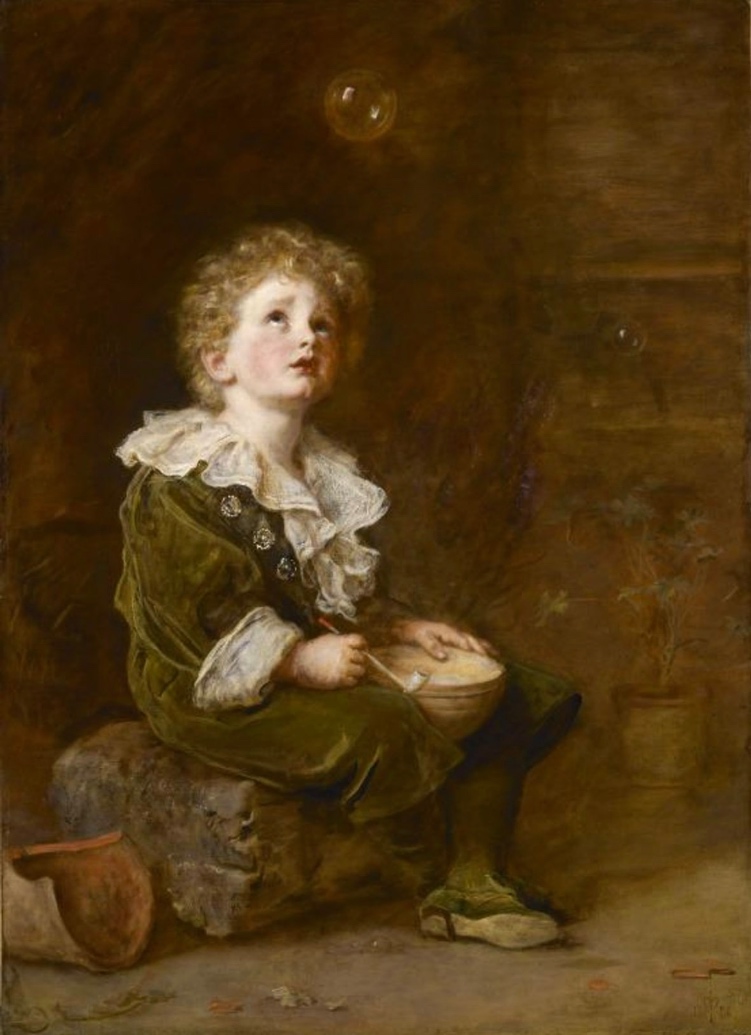
10 Bubbles by John Everett Millais (1829–1896), 1886. Oil on canvas, 102.8 x 73.6 cm.
On loan from Unilever to Lady Lever Art Gallery, Port Sunlight
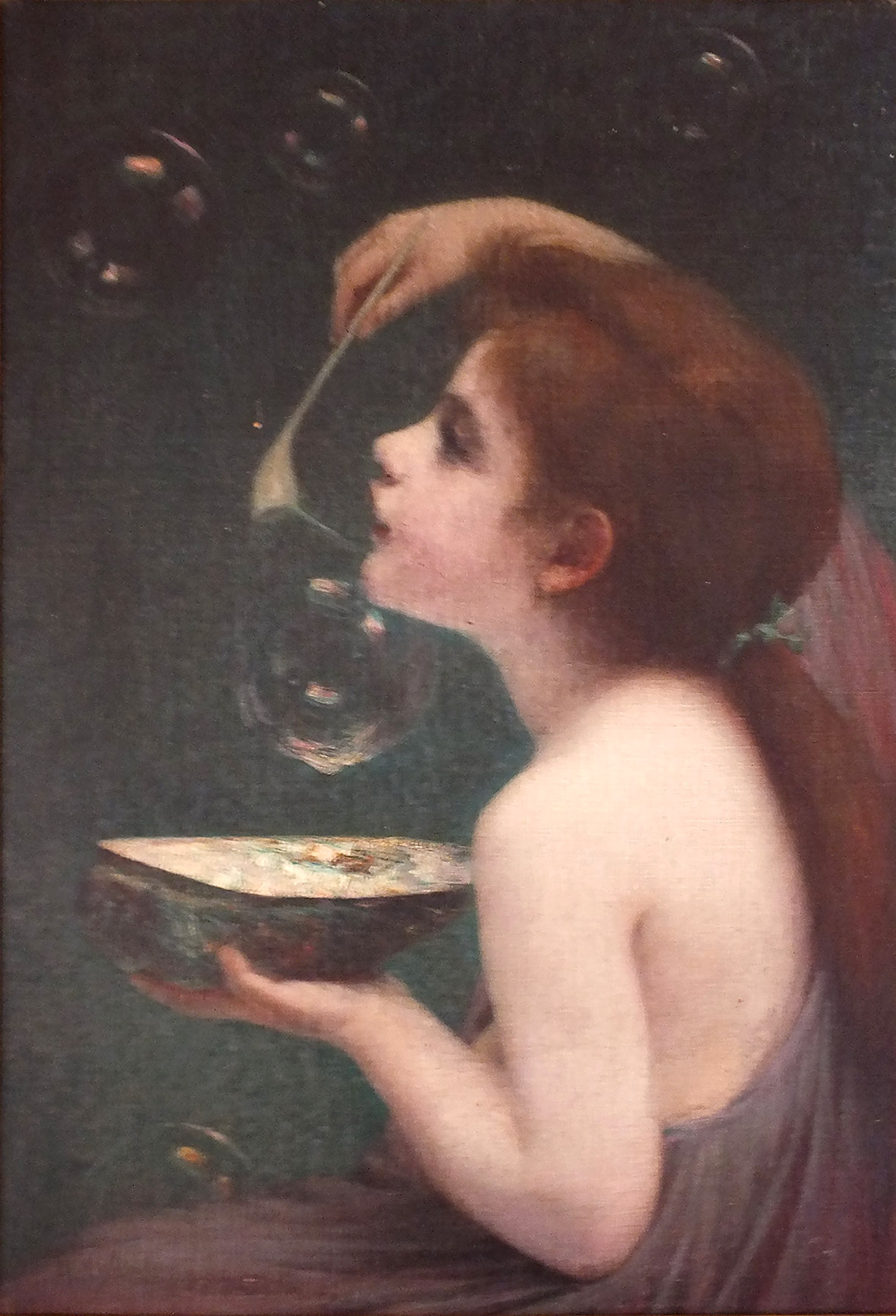
11 Soap Bubbles, 1898. Oil on canvas, 29 x 42.5 cm. Private collection
Her child is a girl facing left and in profile, and she has blown several bubbles, his is a young boy facing half right and gazing upwards at a single bubble. Before any criticism is levelled at Marie for following in Millais’ footsteps, it needs to be said that any debt she owed him is less significant than the debt he owed the 17th-century Dutch painter Gerrit Dou or Dow, one of several continental artists for whom soap bubbles symbolised the beauty, fragility, and brevity of life (Pl 12).
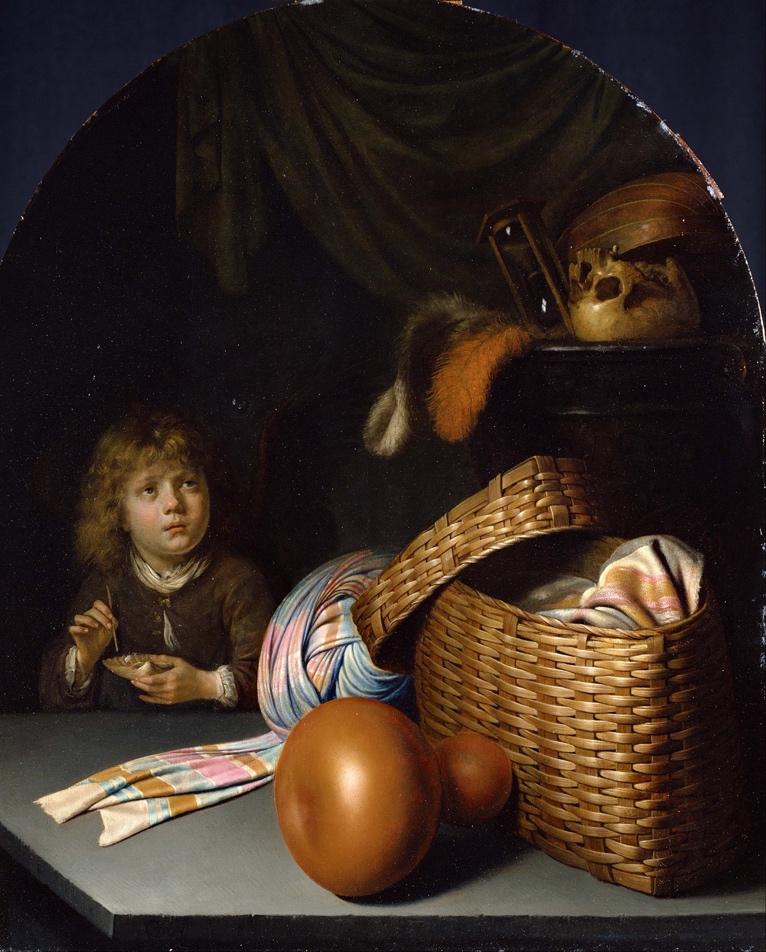
12 Still Life with Boy Blowing Soap-bubbles by Gerrit Dou (1613–1675), c1636. Oil on panel, 48 x 39.7 cm. National Museum of Western Art, Tokyo
After the move into Stamford Bridge Studios, Marie was ‘devoting herself more and more to portrait painting rather than to works of imagination’.[29] One can only guess at the reasons for the change. One possibility is that she herself had fallen out of love with sentimentality. Another is that she may have found portraiture not only intrinsically absorbing and satisfying, but also more profitable in economic terms. The list of the late portraits she exhibited is not long, but it is unlikely that all of her commissioned portraits were exhibited.
Shortly after Marie had the breakdown, the Women’s International Art Club (WIAC), initially the Paris International Art Club, was founded. That was in 1900, and, in view of her close ties to Paris, one might have expected her to have been a founding member, but she was not, perhaps on account of the breakdown. However, she did soon join the club, and in 1903–1904 and again in 1906–1907 served on its Executive Committee.
The latest of Marie’s pictures known to me is her portrait of Mrs Thurston, exhibited in 1908. It is the only one which postdates her emergence as a suffragette as opposed to a suffragist. She explains what happened:
The woman question, particularly as it affects my unfortunate sisters in the gutter has always been of the profoundest interest to me, even during the time of my greatest absorption in the delights of my much-loved profession. Susan B. Anthony deepened my conviction that the want of the vote lay at the root of sex inequality today, and … I often longed for some bolder spirit to step out of the ranks and lead by some more effective action.
When … I at last came in contact with the group of women who formed the vanguard of the so-called militant movement, at a wonderful and electric meeting in the Suffolk-Street Galleries, my heart went out to them at once, and I felt I could follow these women in prison or to death.[30]
This statement is in line with a fuller account she gave in 1913.[31] The meeting that Marie found so inspirational was an ‘At Home’ held on Tuesday 12 February 1907 by the Women’s Social and Political Union (WSPU) during an exhibition of the Society of Women Artists. It was to bring together the provincial delegates to a ‘Votes for Women’ convention at Caxton Hall, Westminster, to be held the next afternoon. About 400 were present to hear leading members of the WSPU speak.[32] Marie first participated in direct action the very next day, 13 February 1907, which happened to be her 51st birthday. There was a women’s suffragist demonstration outside the House of Commons. She was arrested and two days later appeared at Westminster Police Court, accused of seizing hold of a police horse’s reins. She told the magistrate that she was walking away when she was arrested. When he said that he would give her the benefit of the doubt, she provoked laughter in the courtroom by declaring, ‘I don’t wish to be discharged,’ to which he responded, ‘It is not your wish; it is my decision.’[33]
Almost exactly a year later, Marie had her wish. She was arrested during her participation in the so-called ‘Pantechnicon Raid’ on the House of Commons and given a six weeks’ sentence, which she served in Holloway Prison. The raid, inspired by the story of the Wooden Horse at Troy, took place on 11 February 1908 at about 4 pm. Twenty-one suffragettes were conveyed to the House in two removal vans and deposited at the St Stephen’s Hall entrance as part of the campaign to compel politicians to grant women their electoral rights. In the summer, Marie’s status as a leading campaigner was confirmed in her selection as one of 20 women to address a huge ‘Votes for Women’ march and Hyde Park rally, organised by the WSPU, on Sunday 21 June 1908. Each leader spoke to a segment of the crowd from one of 20 numbered platforms. After that, Marie was a tireless campaigner not only in London but also elsewhere, including the West of England. On 9 April 1910 she planted, by invitation of the Blathwayt family, a spruce in the Suffrage Arboretum at Eagle House, Batheston, in commemoration of her imprisonment. She served another prison sentence, this time of 10 days, for breaking a pane of glass at the Home Office in November 1911. That was after the WSPU, out of desperation, had adopted window-breaking as part of its campaign in response to the events of Black Friday (18 November 1910), when women demonstrating in Parliament Square had been brutally assaulted by police officers and some male bystanders. Marie had never caused any wilful damage before but reckoned that damaging windows was a far less serious offence than damaging women’s bodies.
At the height of the WSPU campaign she was anonymously sent a particularly nasty item of hate mail. On opening the parcel, she found that it contained the bloody carcass of a rabbit.[34] The incident would have been upsetting to many even if they were not, like Marie, vegetarian.
There were two organisations for artists prepared to put their professional skill at the service of the promotion of women’s suffrage. One was the Artists’ Suffrage League, the other Suffrage Atelier. If Marie supported either, one would expect it to have been the latter, because that was the one more closely associated with radical campaigners. It would be surprising if she were not roped in, even if she did not volunteer, to use her artistic talent in support of the cause she held so dear, but I do not know of any evidence.
James Fairhead, in his brilliant article ‘An Undocumented Portrait of Christabel and Emmeline Pankhurst: The Suffragette Portraits of Helena Darmesteter (1850–1940)’ in the British Art Journal Online XXV, 2,[35] throws much light on the Anglo-French women’s suffrage activists in Paris. In a private communication to me he points out that they, like Marie, lived in Montparnasse and were linked to the Académie Colarossi, and he believes that Marie must have been close to them. His argument is highly plausible, albeit somewhat speculative in the present state of our knowledge about her. It would certainly be very surprising if she had no contact at all with individuals in the suffrage community during her years in Paris. As we have seen, at one stage her Paris address was the same as Helena Darmesteter’s had been, but it is not clear whether they occupied it at the same time.
Marie carried on campaigning until the outbreak of the First World War on 4 August 1914, when there was a truce with the release of suffragette prisoners. Her work attracted much derision and abuse, often from predictable sources, but sometimes from unexpected ones, as when she and several other women formed a deputation to visit the Bishop of Woolwich and were rudely treated by his butler who even threatened to turn a hose on them as they waited on the doorstep.[36]
I expect that Marie was enfranchised under the Representation of the People Act (1918), but it may be that she had to await the Representation of the People (Equal Franchise) Act (1928). She certainly had one of the two requirements of the 1918 Act, which was for a woman to be at least thirty. But, living in cheap rented accommodation, she might not have met the property requirement.
Her end was a sad one. She died in hospital in Richmond, London, on 30 October 1940, from wounds sustained in the early evening of 9 October, when The Thatch, 165 Petersham Road, Richmond, the home of her nephew Ernest John Naylor and his wife, Ivy May Naylor, took a direct hit from a German bomb. Ernest and Ivy were killed, as was Ellen Louise Naylor, Ernest’s mother and Marie Naylor’s sister-in-law.[37] Marie was eighty-four, and it is likely that she was staying at The Thatch because it was thought to be safer than Stamford Bridge Studios. Whether any of her pictures perished as well is not known. It was the dining-room that took the direct hit, a not unlikely space for the display of paintings. Her funeral took place at Mortlake Cemetery on 5 November 1940. Most of the non-family folk who attended the service are likely to have remembered her better as a suffragette than as an artist, given that she had been absent from the art world for three decades. One indication of the high esteem in which she was held as a campaigner for women’s suffrage is that she was chosen to be one of the 10 pallbearers at Emmeline Pankhurst’s funeral on 18 June 1928.
Marie Jane Naylor: Exhibited pictures and sales[38]
1883/1884 Grapes, RSBA no. 15, £5.5s
1885 From Egypt, RSBA no. 160, £5.5s
1885 In a Strange Land, offered for sale by Dreweatts, Donnington Priory, April 2022, oil on canvas, 43.5 x 33 cm
1886 Blanche, RA no. 1508
‘The study of a head, a not very handsome or pleasant looking face, and in a high Elizabethan ruffle, that doesn’t improve the appearance. The subject, however, is well drawn’ (The Surrey Comet, 15 May 1886, p3)
1886 Autumn Fruit, RSBA no. 161, £5.5s
= SWA 1887
‘An effective study of grapes, apples, and tomatoes’ (Ladies’ Pictorial, 5 June 1886, p3)
1887 “Her Eyes Were with Her Heart, and That Was Far Away”, RHA no. 3, £6.6s
1887 Waiting for Father, RHA no. 63, £15.15s
1887 Marigolds, SWA no. 303, £5
1887 Study of a Head, SWA no. 329, £5
Perhaps = RA 1895
1887 Autumn Fruit SWA no. 357 £5
= RSBA 1886
1887/1888 Study in Blue and Grey, RSBA no. 439, £10.10s
= BB 1898, Gris et bleu
1887/1888 Coquette and Coy (sketch), RSBA no. 445, £10.00
1888 Miss Helen Coombe, Salon no. 1908
= RA 1889; BB 1898; ’91 Club 1899; WIAC 1904 (January)
1888 Edith, RSBA no. 251, £8.8s
= RHA 1889
1888 Florence, RHA no. 159, £8.8s
1888 ‘What’s This Dull Town to Me? Robin’s not Here’,RHA no. 335, £6.6s
1888/1889 Waiting for the Postman, RSBA no. 410, £6.6s
‘Very successful with her [the artist’s] delicate and interesting study of a girl’s face’ (Lady’s Pictorial, 21 December 1889, p894)
1889 Edith, RHA no. 133, £5.10s
= RSBA 1888 (with price reduction)
1889 An Offer of Marriage, my Lady, RHA no. 313, £10.10s
1889 Waiting, oil on canvas, RSBA no. 259, £25
= M 1891
‘A pretty girl in a pale blue gown and large bonnet lined with blue’ (Ladies’ Pictorial, 20 April 1889, p526); ‘A graceful study of a girl waiting for her lover …, the face anxious, the harmony of low colour pleasing’ (The Building News, 5 April 1889, p469)
1889 Before the Dance, RSBA no. 478, £10
‘A girl in gauzy draperies, with a wreath of green leaves in her hair and a gold snake bracelet on her bare arm’ (Ladies’ Pictorial, 20 April 1889, p326)
1889 Miss Helen Coombe, RA no. 476
= Salon 1888; BB 1898; ’91 Club 1899; WIAC 1904 (January)
1889 Portrait de l’auteur, Salon no. 1993
= RA 1990, BB 1898
1890 Portrait of the Artist, RA no. 171
= Salon 1889; BB 1898
1890 Cupid, 61 x 76 cm
Sale Sotheby’s 15 June 1982 no. 151, estimate £1,000–2,000
1890 Un trésor (A Treasure), Salon no. 669
1890 After the Dance, RHA no. 239, £10 10s
1890 Chrysanthemums, RHA no. 259, £2 2s
1890 Post Time, oil on canvas, RHA no. 327, £6 6s
= 1891 M
1890/1891 Portrait de l’artiste, Salon
= 1890 RA; 1898 BB
1891 Woman with Fan-shaped Hair Clips, oil on canvas 48 x 40 cm. Signed by the
artist with her note ‘Paris 91’. No exhibition record. Private collection
1891 Une chansonette (A Little Song), Salon no. 703
Praised in Le Parisien, 8 juin, p1, for its ‘mastery of lines’ and its ‘feminine colouring’
1891 Waiting, M, 9th Autumn Exhibition, no. 164, £25
= 1889 RSBA
1891 Post Time, M, 9th Autumn Exhibition, no. 358, £6.6s
= 1890 RHA
1892 Portrait of Miss Sophie Youngman, Salon no. 774. The subject was the founder (1878) and head (1878–1899) of Ipswich High School for Girls, and the portrait is said to be displayed on the wall of the present head’s office at Woolverstone Hall.
1892/1893 Springtime, ROI no. 505
c1893 Portrait of John Naylor, oil on canvas supplied by Paul Foinet, Paris, 24 x 32.5cm. Private collection
c1893 Portrait of Amelia Denman (?), oil on canvas supplied by Paul Foinet, Paris, 24 x 32.5 cm. Private collection
1894 Meditation, RA no. 780
1894 Sweet Lilac, RHA no. 290, £20
‘Shows a sensitive, if fanciful taste in colour harmonies’ (Irish Society, 17 March 1894, 262)
BB 1898
1894 Little Red Riding Hood, RHA no. 292, £10 10s
Same comment in Irish Society as on Sweet Lilac
1895 Study of a Head, RA no. 729
Perhaps = BB 1898
1895/1896 Sweet Brunette, ROI no. 409, £12 12s
1896 A Tired Love, RA no. 293
‘A weary little cupid slumbering peacefully on a bed of rose-leaves’ (Supplement to Lady’s Pictorial, 30 May 1896, i)
1896 A Little Flower Girl, RA no. 817, oil on canvas
= L 1896 (Autumn)
Sales: Sotheby’s, London, with title Little Girl Holding Flowers, oil on canvas 79 x 54cm, 26 September 1982 no. 155, estimate £500–800. Resold with title Little Girl with Flowers, 26 September 1985, £2,300
1896 (Autumn) A Little Flower Girl, L no. 149, oil on canvas
= RA 1896
1896 La perle (The Pearl), Salon
= BB 1898; WIAC 1903 Finding the Pearl
1898 Portrait de l’artiste, BB
= RA 1890; Salon 1890/1891
1898 Miss Helen Coombe, BB
= Salon 1888; RA 1889; ’91 Club 1899; WIAC 1904 (January)
1898 Lilas (Lilac), BB
RHA 1894
1898 Le miroir (The Mirror), BB. Said to have been previously exhibited at RHA.[39] If this is correct, it must have had a different title
1898 Une petite malheureuse (An Unhappy Little Girl), BB
According to d’Hennebaut, ‘Une charmante tête de fillette’, so perhaps = Study of a Head RA 1895
1898 Gris et bleu, BB
= RSBA 1887/1888
1898 La perle, BB
= Salon 1896; WIAC 1903
1898 Clair de lune (Moonlight), BB
1898 Bulles de savon (Soap Bubbles), BB, oil on canvas, 29 x 42.5 cm. Private collection
= ROI 1898/1899
1898/1899 Soap Bubbles, ROI no. 40, £30
1899 Planning Mischief, RA no. 588, oil on canvas
= L 1899
1899 (Autumn) Planning Mischief, L no. 1146, oil on canvas
= RA 1899
1899 The Evening Star, RA no. 824
1899 Miss Coombe, ’91 Club
= Salon 1888; RA 1889; BB 1898; WIAC 1904 (January)
1900 Lilian, RA no. 1012
1901 Miss Castle, RA no. 105
= WIAC 1903
1902 The Duke of Devonshire Carrying the Orb,
stipple engraving with hand-colouring on cream wove paper, 35 x 21cm, Art Institute of Chicago,
gift of Mrs. James Ward Thorne
1903 The Little Milk-maid, WIAC no. 17, £3 3s
1903 The Evening Star, WIAC no. 27, £15 15s
1903 A Child of the People, WIAC no. 28, £7 7s
1903 Portrait of Miss Castle, WIAC no. 107
= RA 1901
1903 Finding the Pearl, WIAC no. 108, £25
= La perle Salon 1896; BB 1898
‘A fanciful and indeed fascinating design …, the fairy like figure of a pretty boy holding open an oyster shell,
in which he discovers the form of a sweet little girl’
1903 Portrait of Miss A.M. Martineau, WIAC no. 116
1903 Portrait of Canon Holland, WIAC no. 355
1904 (January) Sleep… WIAC no. 114, £21
1904 (January) Portrait: Miss Coombe (Mrs. Roger Fry), WIAC no. 115
= Salon 1888; RA 1889; BB 1898; ’91 Club 1899
1904 (January) An Old Song, WIAC no. 291, oil on canvas, £31.10s
1904 Gertrude, RA no. 533
Probably = Miss Gertrude Aldham, WIAC 1904 (December)
1904 (December) Miss Gertrude Aldham WIAC no. 92
Probably = Gertrude, RA 1904
1904 (December) The Hour Glass, WIAC no. 135, £10 10s
1905 In the Garden, WIAC no. 77, £5
1906 A Sibyl, WIAC no. 103
1908 Mrs. J.N.O. Thurston, WIAC no. 103
Date unknown Sewing by the Fireside, oil on canvas, 50.8 x 66 cm. Sold by Christie’s London, 18 March 2004, US$ 988
Date unknown A Young Country Girl, 54.5 x 44.5 cm
Sale Sotheby’s 5 April 1977 no. 176
Acknowledgements
I thank the following: Andrew Rossiter, a descendant of Amelia Denman, née Naylor; Royal Academy of Arts, London (Mark Pomeroy, Archivist); Durham University Library (Judith Walton); Manchester Art Gallery (Rebecca Milner); Royal Hibernian Academy, Dublin (Susan Dolan); National Art Library, London (Amy McMullen); Royal Scottish Academy, Edinburgh (Robin Rodger); Society of Women Artists (Rebecca Cotton); Walker Art Gallery, Liverpool; Robin Simon; and, for much research and valuable information, Una Richmond (Women’s International Art Club), James Fairhead (Sussex University), and Lucinda Ferguson Smith.
- MF Smith, The Artist Helen Coombe (1864–1937): The Tragedy of Roger Fry’s Wife, London 2023, p19n3. ↑
- Smith, pp19–26. ↑
- The rules of admission for students entering in 1882 are given in The Year’s Art 1882, pp109–111. ↑
- RAA/SEC/8/15. ↑
- RAA/PC/1/XVIII, 92. ↑
- ‘Paris Artistique: L’Académie Colarossi’, The Ladies’ Field, 20 May 1899, p97. ↑
- The Queen, 9 February 1889, p173. ↑
- C d’Hennebaut, ‘Petits Salons: exposition de Miss Marie Naylor’, Le moniteur des arts 43, nouvelle série 34, 3 juin 1898, p559. ↑
- 2 juin 1889. ↑
- 12 mars 1889. ↑
- The Building News, 9 May 1890, p647. ↑
- 5 May 1888. ↑
- 22 May 1889, p15. ↑
- 8 May 1889, p3. ↑
- ‘Les Petits Salons: Exposition Naylor’, Journal des Artistes, 26 juin 1898. ↑
- 24 June 1899, p1059. ↑
- The Queen, 9 February 1889, pp173–175. ↑
- The Daily Illustrated Mirror, 27 January 1904, p2. ↑
- The Times, 18 January 1904, p4. ↑
- Votes for Women, 7 May 1908, p144. ↑
- Peter Trippi, J.W. Waterhouse, London 2002, pp37–38. ↑
- The Women’s Suffrage Movement: A Reference Guide 1866–1928, London 2001, p442. ↑
- Life, 25 August 1894, p13. For a black and white reproduction of her Meditation, exhibited at the RA in 1899, see The Ladies’ Field, 29 July 1899, p366. ↑
- A Royal Academy Supplement of The Magazine of Art, 1889, 1890, London. ↑
- Smith pp26, 227–231 and pl 57. ↑
- Votes for Women, 7 May 1908, p144. ↑
- On the Stamford Bridge Studios, see Austin Wormleighton, Lost World: the Untold Story of London’s Stamford Bridge Studios, Stockbridge 2012. ↑
- Votes for Women. ↑
- Votes for Women. ↑
- Votes for Women. Marie dates the meeting to ‘spring 1907’, but it was actually on 12 February 1907. ↑
- Marie Naylor, ‘How I Became a Militant’, The Suffragette, 10 January 1913, p190. ↑
- The Times, 13 February 1907, p12. ↑
- Newcastle Daily Chronicle, 15 February 1907, p11. ↑
- Wormleighton, p46. ↑
- http:/britishartjournal.co.uk/an-undocumented-portrait-of-christabel-and-emmeline-pankhurst ↑
- The Derbyshire Advertiser, 28 March 1914, p10. ↑
- ‘Killed by Enemy Action’, The North Devon Journal, 17 October 1940, p2. ↑
- This compilation is not to be considered anything like complete. Many sources have been systematically tapped, including records of exhibitions at the BB, ’91 Club, RA, RHA, ROI, RSBA, SWA, and WIAC, but many others, on both sides of the English Channel, are bound to have been missed. Ars longa, vita brevis! It would be welcome if the list helped bring about the identification or discovery of more of Marie’s work. ↑
- Eugène Hoffmann. ↑